
Tesla's Vision
Musk is pitching Tesla humanoid robots as a fix for the debt - grow GDP fast enough to outrun spending. I think the bigger question is who actually captures the gains.
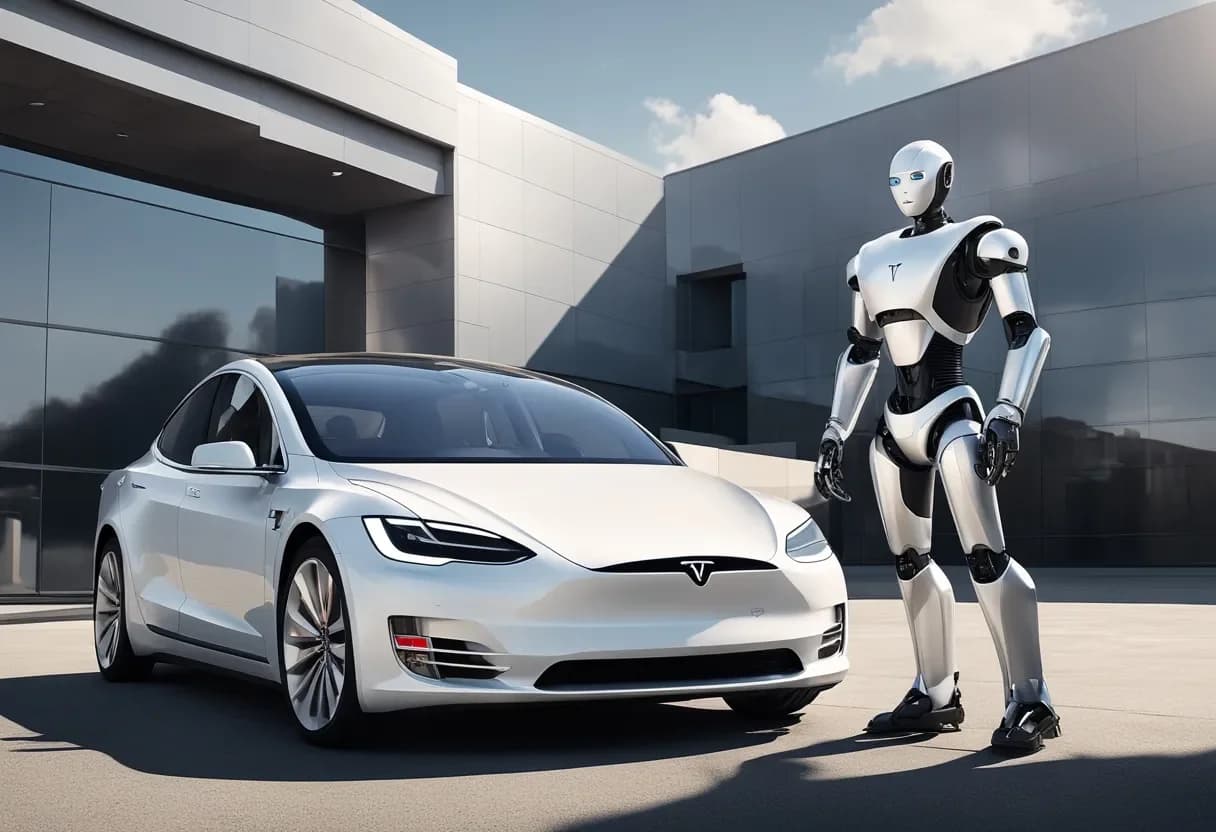
How Humanoid Robots Could Solve America's Economic Challenges
With federal spending climbing and political gridlock deepening, a bold new idea is emerging—not from Washington, but from Elon Musk.
Tesla is quietly positioning its humanoid robot program not just as a product line, but as a macroeconomic strategy. The pitch is audacious: if we can’t cut spending, then we must grow GDP fast enough to outrun the debt. And the fastest path to growth? Automation at planetary scale.
While most eyes are on Tesla’s upcoming robotaxi launch, the real disruption may come from humanoid robots that can watch, learn, and replicate human labor—from household chores to warehouse logistics. At $30–40K per unit and multi-year utility, the economic impact could be transformative.
Inside this analysis:
How Tesla’s robotics strategy aims to boost GDP, not just profits
Why Musk appears to be pivoting away from politics and back to pure innovation
What happens when humanoid robots go mainstream across services, labor, and logistics
And whether this wave of automation could redistribute wealth—or deepen inequality
This isn’t just a tech bet. It’s a wager that productivity, not policy, will define the next chapter of the American economy.
In a fascinating development that signals a potential shift in both technological innovation and economic strategy, Tesla appears to be doubling down on its humanoid robot program as a solution to America's mounting fiscal challenges. Recent interactions between Elon Musk and the tech community suggest that Tesla's focus is increasingly centered on developing advanced robotics technology as a means to dramatically boost economic growth and productivity.
The core premise is both simple and revolutionary: with government spending continuing to rise and little political will to reduce it, the only viable path forward may be to dramatically increase GDP growth through technological innovation. Tesla's humanoid robots, combined with their autonomous vehicle technology, could be the key to achieving this ambitious goal.
The company's strategy appears to be unfolding on multiple fronts. While Tesla prepares to launch its autonomous taxi service in Austin this summer, significant progress is being made on the humanoid robot front. Recent demonstrations have shown these robots performing increasingly complex tasks, from intricate dance movements to learning new skills simply by observing human actions. This rapid advancement suggests that practical applications may be closer than many realize.
The economic implications of this technology are profound. Consider a future where humanoid robots, costing between $30,000 and $40,000 each, can perform a wide range of tasks for 5-10 years with minimal maintenance. This could revolutionize everything from household services to manufacturing, making previously expensive services accessible to a broader segment of the population. House cleaning, lawn care, construction, warehouse operations, and food delivery could all become significantly more affordable and efficient.
However, this technological revolution also presents significant challenges. As autonomous vehicles and robots replace human workers in various sectors, questions arise about job displacement and economic transition. Traditional drivers, factory workers, and service industry employees may find themselves needing to adapt to new roles in an increasingly automated economy. This transition could be particularly challenging for legacy companies and industries that are slow to adapt to technological change.
Yet within this challenge lies an interesting possibility for wealth redistribution. As traditional "value" companies struggle to adapt to this new paradigm, we might see a significant transfer of wealth to a new generation of technologically savvy entrepreneurs and businesses. Those who understand and embrace these emerging technologies could find themselves at the forefront of a new economic order.
The shift in Tesla's focus, particularly with Musk's apparent stepping back from political engagement to concentrate on these technological developments, suggests a belief that private sector innovation, rather than political solutions, may be the key to addressing our economic challenges. This approach represents a bet that by dramatically increasing productivity and efficiency through automation, we can generate enough economic growth to outpace our current fiscal challenges.
As we move forward, the success of this strategy will likely depend not just on the technology itself, but on our ability to manage the transition effectively and ensure that the benefits of automation are broadly distributed throughout society. The coming years will be crucial in determining whether this technological revolution can indeed deliver on its promise of economic transformation while addressing the inevitable disruptions it creates.
This evolution in Tesla's strategy and its potential impact on our economic future represents one of the most significant technological and economic experiments of our time. The outcome could reshape not just how we work and live, but the very structure of our economy and society.