
Starship V3: Doubling Saturn V Thrust to Unlock Million-Ton Orbital Capacity and Space AI
Starship V3 already beats twice the Saturn V's thrust, and once cadence hits a flight an hour, mass to orbit jumps into the millions of tons. That's the real story for orbital AI.
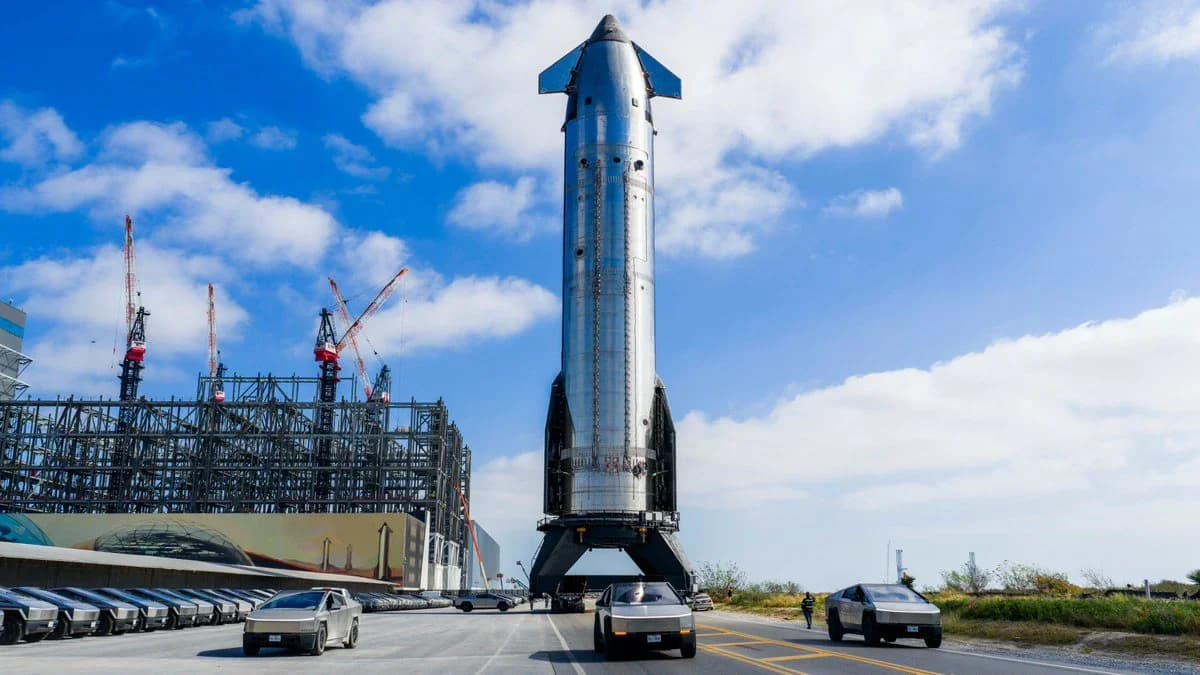
How rapid reusability and purpose-built satellites shift compute infrastructure from ground constraints to solar-powered orbital scale
Starship Version 3 produces more than twice the thrust of the Saturn V rocket that powered the Apollo program. Version 4 extends that margin toward three times the historic benchmark. These gains, paired with flight rates exceeding one per hour, move annual mass delivery to orbit from roughly 2,500 tons industry-wide today to the million-ton range within about three years. The same vehicles that enable this throughput also support a new generation of satellites optimized for AI workloads, where solar arrays generate power and radiators reject heat directly into space.
Key Takeaways
Starship V3 thrust exceeds twice the Saturn V level, with Version 4 approaching three times that output, directly multiplying payload mass per flight.
Mature operations target launch cadence above one flight per hour, turning space access into high-volume industrial activity rather than episodic events.
SpaceX currently delivers 85–90 percent of all mass placed into Earth orbit; Starship operations aim to expand total global capacity by orders of magnitude.
Annual mass to orbit could scale from approximately 2,500 tons to over one million tons per year within roughly three years once Starship reaches full cadence.
Recent record payloads represent only a small fraction of what operational V3 vehicles will carry routinely on each flight.
Orbital AI platforms take the form of compact satellites rather than conventional data-center buildings lifted into space, focusing on integrated power generation and thermal rejection.
AI satellites require less hardware complexity than Starlink units, needing primarily solar cells, radiators, and laser links instead of large phased-array antenna systems.
Early AI satellite designs target 150 kilowatts peak power while sustaining about 120 kilowatts of continuous compute, based on actual large-scale AI cluster performance.
Members only
The rest of this issue is part of the Farzad Corner membership. Sign in if you're already a member, or join to get access.