
Stop Thinking Small: The Moon as the Gateway to Kardashev-Scale Energy and Compute
Earth caps how far energy and compute can scale. I think lunar manufacturing plus mass drivers breaks the ceiling - and opens the Moon to the rest of us along the way.
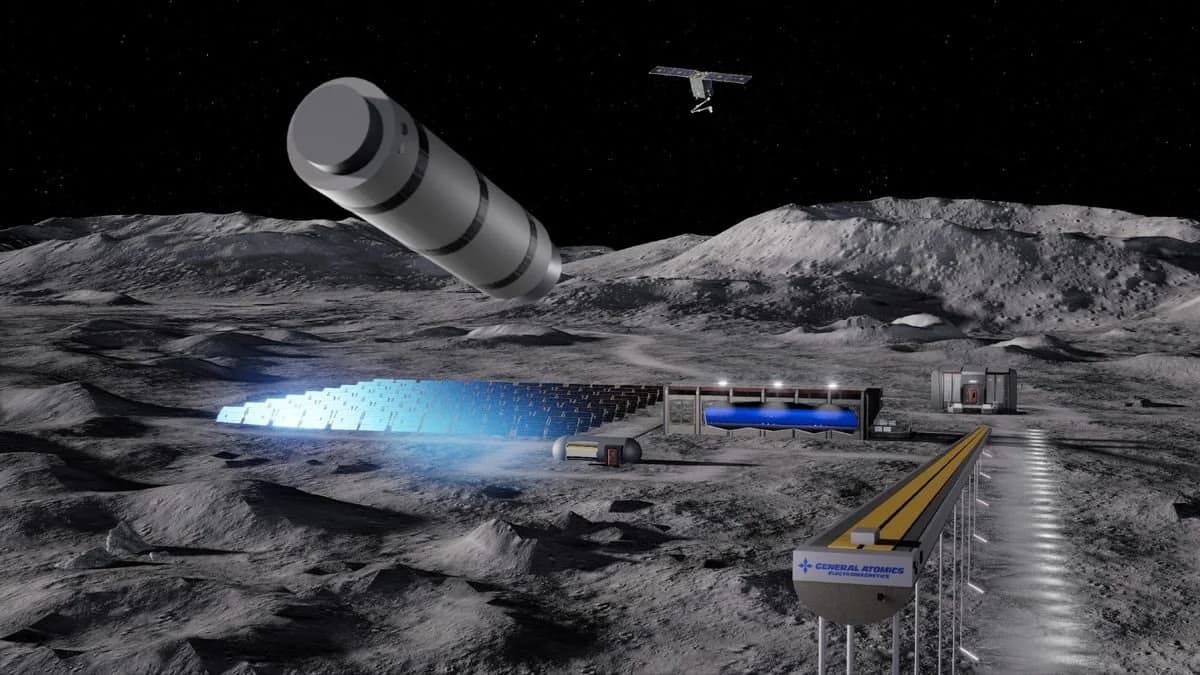
Lunar in-situ manufacturing combined with electromagnetic mass drivers creates a practical route to 1,000x energy growth and large-scale deployment of AI satellites in deep space.
Current terrestrial limits on land, materials, and launch costs cap how far energy production and computational infrastructure can scale. Shifting the bulk of manufacturing to the Moon and using its physical properties for efficient electromagnetic launches removes those ceilings. The result is a system capable of producing and deploying the massive solar arrays, radiators, and AI-optimized satellites required to push civilization measurably closer to stellar energy levels.
Key Takeaways
Global energy use sits at roughly 20 terawatts today; even a 1,000x increase remains a small fraction of the output needed for Kardashev Type II status.
The Moon’s one-sixth Earth gravity and total lack of atmosphere allow local production of heavy components like solar panels and thermal radiators with far lower energy input than lifting equivalent mass from Earth.
Electromagnetic mass drivers function as long linear motors that accelerate payloads to lunar escape velocity without onboard propellant, enabling high-volume launches of finished satellites into deep space.
In-situ resource utilization on the Moon means most of the mass for solar power systems and satellite structures comes from lunar regolith rather than Earth shipments.
AI satellites gain continuous solar power and the large radiator surfaces needed for heat rejection in vacuum—both difficult to scale when everything must launch through Earth’s atmosphere and gravity well.
Industrial-scale lunar operations create the logistics backbone that simultaneously makes routine human access to the Moon feasible and affordable.
Reusable heavy-lift rockets handle the initial delivery of specialized equipment and crews, after which lunar production takes over for bulk materials and reduces long-term Earth dependency.
The Kardashev Scale and Why Earth Alone Falls Short
The Kardashev scale measures a civilization’s technological advancement by the amount of energy it can harness. Type I corresponds to the full resources of a planet, roughly 10^16 to 10^17 watts. Type II reaches the full output of its star, around 10^26 watts. Type III extends to galactic scale. Humanity’s present average power consumption of about 20 terawatts places us well below even a mature Type I civilization.
Incremental improvements on Earth—more solar farms, advanced nuclear, or efficiency gains—face hard physical and logistical constraints. Available land for ground-based arrays, mining rates for rare materials, grid infrastructure limits, and the environmental trade-offs of further terrestrial expansion all impose ceilings. The physics of escaping Earth’s deep gravity well with chemical rockets compounds the problem: most of any rocket’s mass is propellant, not payload. These realities make orders-of-magnitude growth in energy and compute capacity impractical if everything must originate and launch from Earth’s surface.
Lunar Manufacturing: Using Local Resources at Scale
The Moon changes the arithmetic. Its regolith contains silicon, aluminum, iron, and other elements that can be processed into photovoltaic cells, structural materials, and thermal control components. Concepts for extracting and refining these resources in place have been studied for decades. Because the Moon has no atmosphere, there is no wind loading, no corrosion, and no need for heavy weatherproofing on large structures. Gravity at one-sixth Earth normal reduces the structural mass required for factories, solar arrays, and assembly facilities.
Most of the mass for a large solar power installation or satellite constellation can therefore be produced on-site. Only the highest-value, lowest-mass items—advanced semiconductor chips, precision electronics, or specialized manufacturing tools—need to come from Earth initially. This division of labor slashes the total mass that must be lifted out of Earth’s gravity well, which in turn reduces the number of rocket launches and the overall energy cost of building the system.
Electromagnetic Mass Drivers: Launch Without Propellant
Once components are manufactured on the Moon, they still need to reach useful orbits or deep-space trajectories. An electromagnetic mass driver solves this efficiently. The system is essentially a long, straight-track linear motor. Sequential coils generate traveling magnetic fields that push a carrier sled holding the payload. Acceleration occurs over hundreds or thousands of meters, keeping peak forces manageable even for delicate electronics or large radiator panels.
Lunar escape velocity is only about 2.4 km/s—roughly one-fifth of Earth’s. Without an atmosphere, there is no drag or heating during the initial acceleration phase. Once the payload reaches the required speed, it simply separates from the sled and coasts away on a ballistic trajectory. No chemical propellant is burned during launch itself. The energy for the mass driver can come from the same lunar solar arrays being produced. This architecture supports continuous, high-cadence launches of AI satellites equipped with substantial solar collection area and large thermal radiators optimized for the space environment.
Power and Cooling for Next-Generation AI
High-performance AI hardware generates significant waste heat. On Earth or even in low Earth orbit, dissipating that heat at scale requires either massive air or liquid cooling infrastructure or limited radiator area. In deep space, heat rejection occurs solely through thermal radiation into the cosmic background. Large, lightweight radiator surfaces become essential. Manufacturing those surfaces on the Moon and launching them complete via mass driver removes the launch-mass penalty that would apply if every square meter had to climb out of Earth’s gravity well.
At the same time, properly positioned solar arrays in space receive uninterrupted sunlight. The combination of locally produced solar power and space-based radiators allows AI satellite constellations to operate with energy abundance and thermal stability that are difficult to replicate when every watt and every kilogram must fight Earth’s launch constraints. Distributed compute nodes spread across multiple satellites also offer resilience and the potential for specialized orbital placements that minimize latency for certain workloads or avoid terrestrial interference.
Human Access as a Natural Byproduct
The same industrial base required to move and process the enormous quantities of lunar material for solar arrays and satellites creates the transportation capacity for people. Vehicles that deliver factory modules, mining equipment, and initial crews can later carry researchers, technicians, and eventually settlers. Once a mass driver is operating and lunar production is mature, the marginal cost of additional payload drops sharply. What starts as an energy-and-compute project becomes the foundation for routine lunar access. Anyone with the means and interest can reach the Moon; permanent habitation becomes a realistic option rather than a rare event.
The Bootstrap Role of Reusable Launch Systems
Fully reusable heavy-lift vehicles remain critical during the early phases. They carry the first wave of precision manufacturing tools, chip fabrication equipment, and trained personnel that lunar industry cannot yet produce. High flight cadence and rapid reuse lower the cost per kilogram delivered to the lunar surface. Over time the dependency shifts: bulk regolith-derived materials and simple structures come from the Moon itself, while Earth continues to supply advanced electronics and specialized components. The hybrid architecture—reusable rockets for high-value cargo plus lunar mass drivers for high-volume finished goods—creates a resilient supply chain capable of supporting exponential growth.
This approach does not require revolutionary breakthroughs in physics, only disciplined application of existing engineering principles to the Moon’s unique environment. Local production removes the mass bottleneck. Electromagnetic launch removes the propellant bottleneck. The resulting capacity for solar power and AI infrastructure scales in ways that Earth-bound systems cannot match. The same infrastructure that enables stellar-level energy ambitions also opens the Moon to broader human presence, turning a single strategic shift into simultaneous progress across energy, compute, and exploration.